Education is often described as the key to opportunity. But for millions of girls across Africa, the opportunity to learn is still shaped by where they live, how much their families earn, social expectations, access to basic resources, and whether their schools are equipped to support them.
At A Thousand Women, we believe education is about more than being able to sit in a classroom. It is about having the knowledge, confidence, resources and support to imagine a different future and have the tools to pursue it.
When a girl is given the opportunity to learn, the impact does not stop with her. It can reach her family, her community and, eventually, generations that come after her.
That is why we see education as one of the foundations of empowerment.
Education Is More Than a Classroom
For many girls, simply having a school to attend does not guarantee that they can participate fully.
Poverty can make uniforms, books, transportation and other learning materials difficult to afford. Social and cultural expectations can place pressure on girls to prioritise domestic responsibilities, marriage or caregiving over education. In some communities, concerns around safety, sanitation and menstrual health can also affect whether girls remain in school.
UNICEF identifies poverty, child marriage, gender-based violence, inadequate sanitation and gender-discriminatory norms among the barriers that can prevent girls from accessing and completing education.
In Nigeria, these challenges are particularly significant. UNICEF reports that around 10.5 million children aged 5–14 are out of school, while gender, poverty, geography and social norms contribute to educational exclusion.
This is why building educational opportunity requires more than simply telling girls to stay in school.
It requires us to ask a more important question:
What does a girl need in order to learn, remain in school and thrive?
When a Girl Can Learn, Her Possibilities Expand
Education can change the choices available to a girl.
It can help her develop literacy, critical thinking, communication and problem-solving skills. It can give her access to information about her rights, her health and her future. It can strengthen her confidence and help her participate more actively in decisions that affect her life.
UNICEF notes that girls who receive an education are more likely to lead healthy and productive lives, earn higher incomes and participate in decisions affecting themselves and their families.
The World Bank similarly describes girls' education as an investment in human capital, employment and poverty reduction.
In other words, educating a girl is not simply about preparing one person for a job.
It is about expanding her ability to make choices.
And when women have greater access to education and economic opportunity, those benefits can extend far beyond the individual.
The African Context
Africa has made significant progress in expanding access to education, but serious inequalities remain.
UNICEF highlights both the progress made over recent years and the significant equity challenges that remain across the continent.
The continent also has an exceptionally young population, meaning the quality and accessibility of education today will have enormous implications for Africa's future.
For adolescent girls, the transition through secondary education is particularly important.
The World Bank reports that in Sub-Saharan Africa, although more adolescent girls are entering school than ever before, secondary-school completion remains a major challenge.
The goal, therefore, should not simply be getting girls into classrooms.
" It should be helping girls stay, learn, complete their education and move confidently into the next stage of their lives."
Education and Menstrual Equity Are Connected
For A Thousand Women, this connection is particularly important.
A girl cannot fully benefit from education if something as basic as menstruation becomes a reason for her to miss school.
Menstrual health is therefore not separate from education. It is part of creating an environment in which girls can participate with dignity.
UNICEF identifies menstrual hygiene management among the practical issues that education systems need to address when working to remove barriers to girls' education.
This is something we have encountered through our own community work.
Our programmes have included educational support alongside menstrual health education and the distribution of menstrual products. Through our outreach work, we have supported more than 1,000 girls and distributed more than 5,000 menstrual products, while also providing educational resources and creating spaces where girls can learn, ask questions and feel supported.
These numbers matter, but the reason behind them matters even more.
A sanitary product can help a girl attend school during her period.
An educational supply pack can give a child tools to participate in class.
A conversation can give a girl information she may not have had before.
And encouragement can help her begin to see herself as someone capable of more.
Our Work: Creating Opportunities Through Education
At A Thousand Women, our approach to education is rooted in the belief that empowerment begins with access.
Our education-focused outreach has included the distribution of educational supplies, menstrual health education, empowerment conversations and practical support for girls within school and community settings.
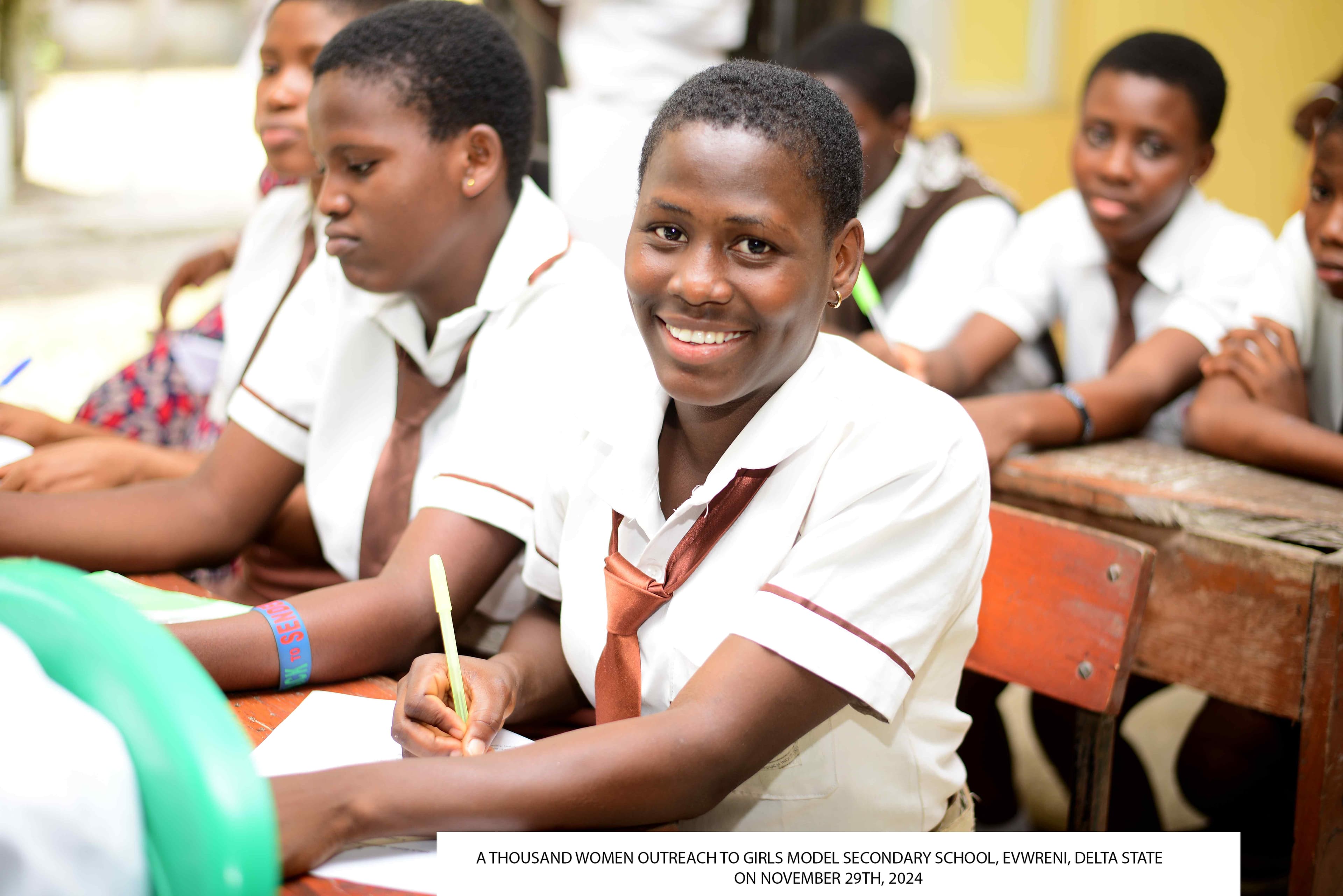
One of our education outreach programmes brought together students, volunteers and community partners for a day centred on learning, empowerment and wellbeing.
We distributed more than 250 educational supply packs, giving students practical materials to support their learning.
But the programme was not only about what was inside the bags.
It was also about what happened in the room.
We created space for conversations around menstrual health and hygiene. We spoke with students about confidence, their futures and the importance of believing in their own potential.
For us, this is what community education should look like.
"It should not simply tell young people what to know. It should give them opportunities to ask, understand, participate and imagine."
Building Communities, Not Just Programmes
The work of education cannot rest on schools alone.
Parents, teachers, community leaders, organisations, governments and young people themselves all have a role to play in creating environments where girls can thrive.
These challenges require connected solutions.
UNICEF highlights interventions such as social protection, school feeding, transportation support and healthcare as measures that can contribute to improved participation and progression in education.
" Empowerment cannot happen in isolation."
The Ripple Effect of Educating Girls
One of the most powerful things about education is its ripple effect.
A girl who learns may become a woman who earns.
A woman who earns may support her family.
A woman who understands her rights may advocate for herself and others.
A woman who has had access to opportunity may create opportunities for someone else.
This is why the phrase "Empowered women, empower generations" is central to our work.
What We Still Have to Do
There is still significant work ahead.
We need education systems that recognise the different barriers girls face. We need communities where girls' education is valued. We need schools that are safe and inclusive. We need menstrual health to be treated as part of educational wellbeing rather than an afterthought.
And we need to keep listening to girls themselves.
"The most effective solutions cannot simply be designed for girls. They must be informed by their experiences, their realities and their aspirations."
Building the Future Together
At A Thousand Women, we are committed to creating opportunities for women and girls through education, empowerment and advocacy.
Our work is still growing, and every programme teaches us something new about what communities need and where more support is required.
We believe that meaningful change is built over time.
It happens when a girl receives the materials she needs to learn.
When she is able to attend school during her period without shame.
When she hears someone tell her that her dreams are valid.
When she gains the knowledge to make informed decisions.
When a community decides that its girls deserve every opportunity available to its boys.
And when those individual moments begin to add up.
"Education can open a door.
Community can help a girl walk through it."
And when we invest in both, we create the possibility of generations of women who are not simply surviving, but learning, leading and shaping the future.
That is the future we want to help build.
Because when women are empowered, generations are empowered.